Pricing intelligence: charging for outcomes, not seats
Seat-based pricing assumes humans do the work. What happens to SaaS economics when they don’t.
Contents7 sections
Seat-based pricing made sense when software was primarily a tool used by people.
More employees meant more users.
More users meant more seats.
More seats meant more revenue.
Agentic software weakens that relationship.
If one person can supervise a system that performs work previously distributed across several roles, then headcount stops being a reliable measure of product value.
That creates a pricing problem.
It also creates an opportunity.
Seats price access, not work
A seat tells you who can log in.
It does not tell you what the software actually did.
That distinction was less important when the user was performing most of the work themselves. The product provided leverage, but the employee still executed the process.
Agentic systems can take responsibility for parts of the process directly.
They may qualify leads, follow up, reconcile information, generate outputs, update systems, route exceptions or complete repetitive operational tasks.
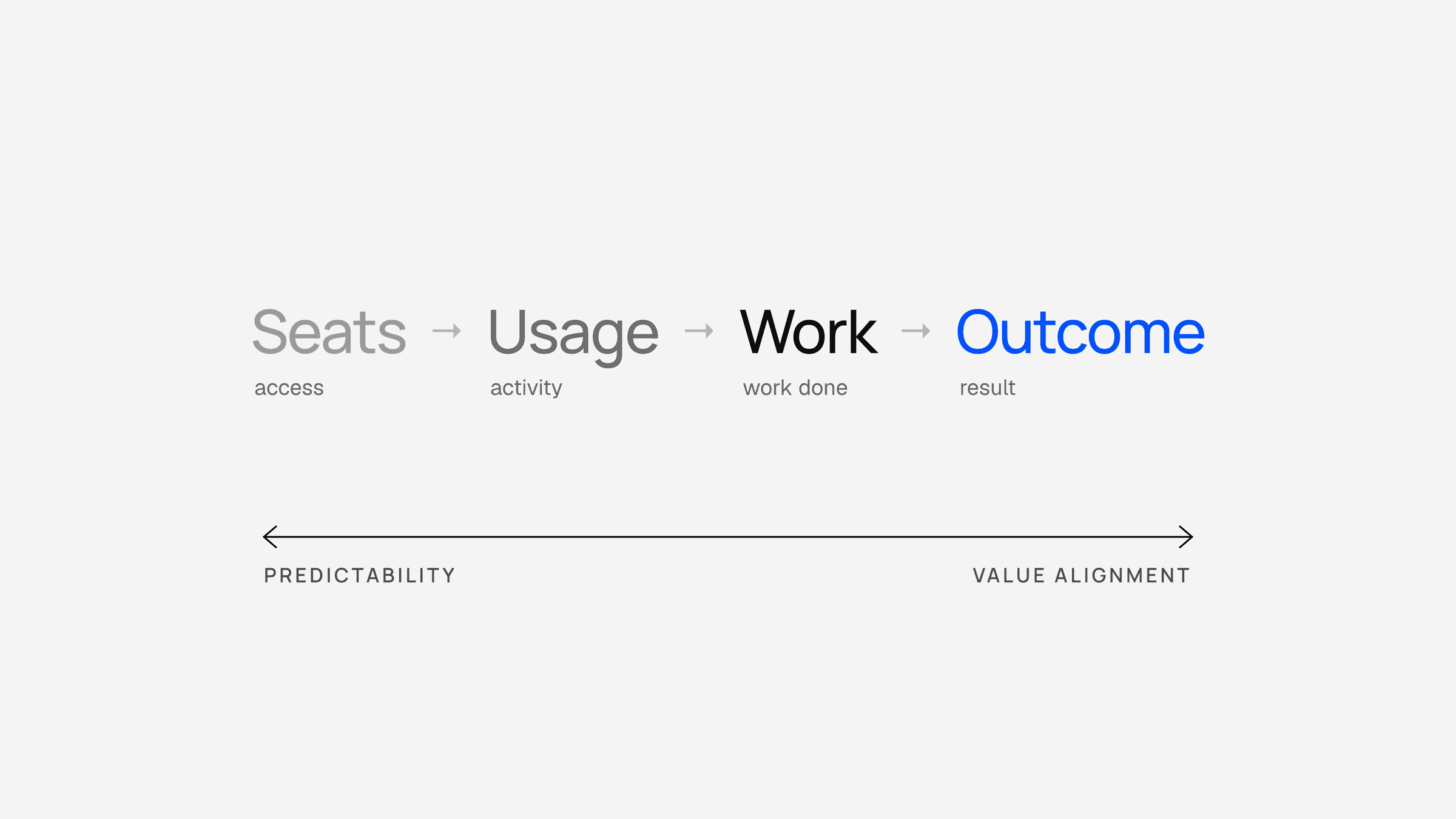
The value is increasingly tied to activity and outcome rather than access.
Charging per seat can therefore create strange economics.
The product becomes more valuable precisely because the customer needs fewer people interacting with it.
Yet the pricing model charges less.
Usage is better, but not always enough
Usage-based pricing solves part of the problem.
Charge for messages, calls, tokens, documents, tasks or workflow runs.
That aligns revenue more closely with activity.
But raw usage can still be a poor proxy for value.
A thousand low-value classifications and one successfully completed high-value workflow should not necessarily cost the same simply because their compute profile is similar.
Customers do not buy tokens. They buy outcomes.
The harder problem is finding a unit that reflects both the value created and the cost of delivering it.
| Model | Measures | Fits when | Watch for |
|---|---|---|---|
| Seat-based | Who can log in | People do most of the work | Value rising as fewer people need seats |
| Usage-based | Messages, calls, tokens, documents, tasks or runs | Revenue should track activity | Raw usage as a poor proxy for value |
| Hybrid | A platform fee, usage and measurable outcomes | Outcomes are only partly in the product’s control | The unit still needs to stay understandable and predictable |
| Outcome-linked | Outcomes the product materially produces | The result is measurable | Results that depend on things outside its control |
The unit of value is changing
Different products will need different answers.
A sales agent might price around:
- qualified opportunities;
- conversations handled;
- meetings booked;
- pipeline influenced.
A finance product might price around:
- entities managed;
- reconciliations completed;
- reports generated;
- transactions processed.
A service-delivery platform might price around:
- cases completed;
- requests processed;
- successful submissions.
The right unit should be understandable to the customer and observable by the product.
If the customer cannot predict the bill, the model creates anxiety.
If the product cannot measure the outcome reliably, the model creates disputes.
Outcome pricing has limits
“Charge for outcomes” sounds ideal until the outcome depends on things outside the software’s control.
A sales agent can book a meeting. It cannot guarantee the prospect will buy.
A recruiting agent can source candidates. It cannot guarantee the company will hire them.
A support agent can resolve a request. It cannot guarantee the customer will remain satisfied.
That is why hybrid models are likely to remain common.
- A platform fee provides predictability.
- Usage reflects operational load.
- Outcome-based components capture value where the result is measurable.
Agentic software looks partly like software and partly like labour
This is where the economics become interesting.
Traditional SaaS has very high gross margins because the customer supplies the labour.
Services businesses have lower margins because the provider supplies the labour.
Agentic products sit somewhere between the two.
The provider may be supplying:
- model inference;
- workflow infrastructure;
- monitoring;
- human escalation;
- data operations;
- integrations;
- support;
- continuous tuning.
That means the cost to serve may scale with actual work performed.
The pricing model needs to recognise that.
A flat £20-per-seat subscription may be structurally wrong for a product that is effectively doing £2,000 worth of operational work.
Managed intelligence changes packaging
There is also a packaging question.
Some customers will want a product.
Others will want the outcome without caring how the system is configured.
That creates a spectrum:
- SoftwareThe customer configures and operates the system.Tool
- Managed softwareThe provider helps deploy and tune it.Service
- Managed intelligenceThe provider owns more of the operational result, with agents and humans working together behind the service.Outcome
As products move along this spectrum, pricing starts to resemble a combination of SaaS and service economics.
That is not necessarily a weakness.
For many SMEs, buying an outcome is more attractive than buying another tool.
Pricing should reinforce the product promise
The strongest pricing models make the product easier to understand.
If a company says its agent replaces repetitive manual work but charges per employee seat, the commercial model contradicts the product story.
If it says it delivers completed workflows but bills only for API calls, the customer has to translate infrastructure usage into business value themselves.
Pricing is part of product design.
It tells the customer what the company believes the value actually is.
As software takes on more responsibility, that value is moving away from access and toward work completed.
The challenge is not simply finding a new metric.
It is choosing a unit that makes the economics of intelligence legible to both sides.